Culebra in Words · Featured work
The Ocean Lantern
By Efraín Nadal de Choudens
A new-moon night at Flamenco Beach, a blue light above the reef, and the memory of a fisherman who never left his own behind.
To understand the sea around the island of Culebra, you must first understand the darkness of its new-moon nights. In eastern Puerto Rico, where the waters of the Atlantic Ocean blur into the Caribbean Sea in a violent embrace of currents, Culebra rises like a secret of volcanic rock, dense mangroves and sand that looks like stardust. When the moon hides completely, the world is erased. There is no dividing line between sky and sea; everything becomes a black abyss, an absolute void where the senses fail and the only possible north is the rhythmic sound of the swell breaking against the coral reef.
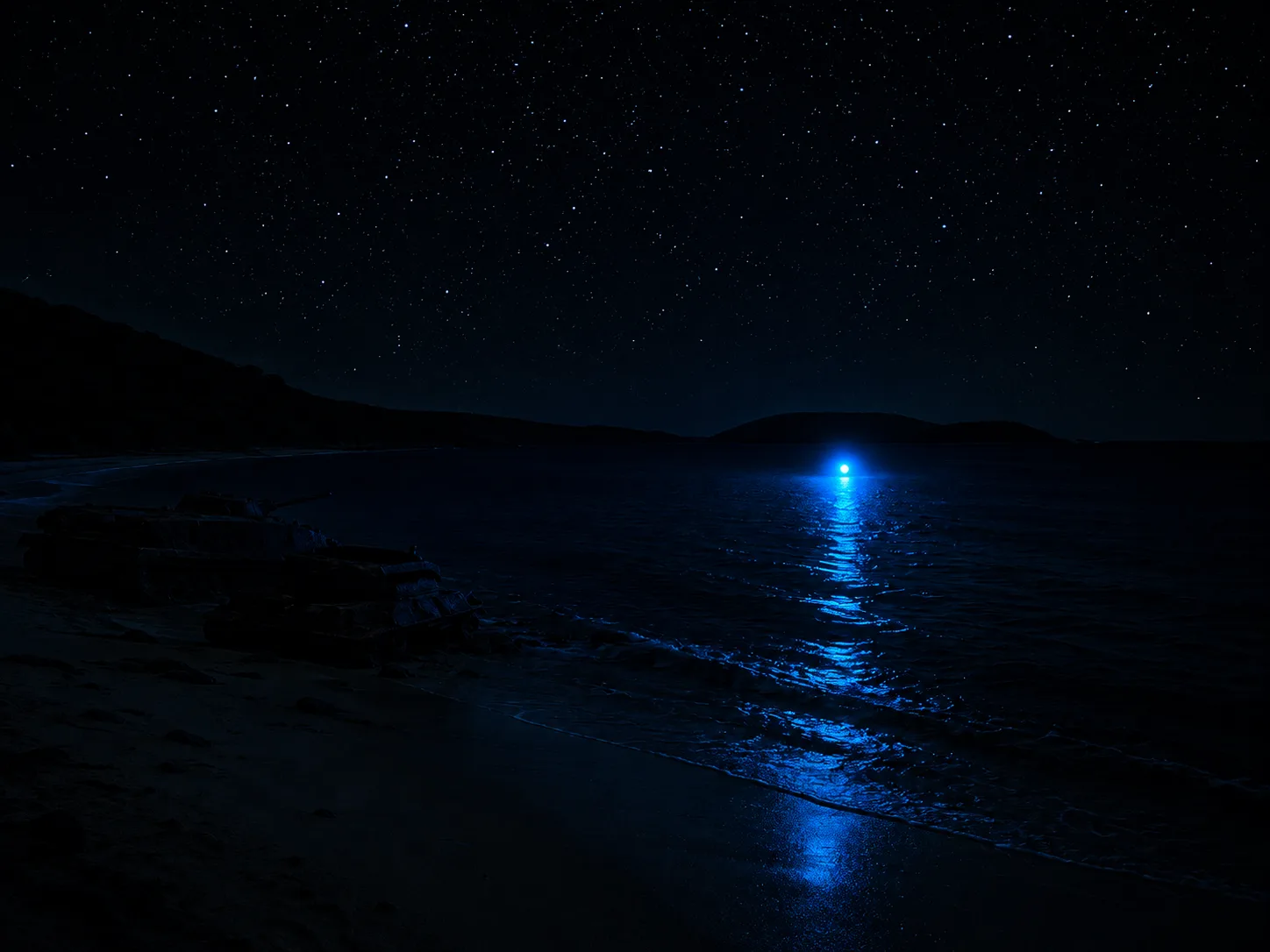
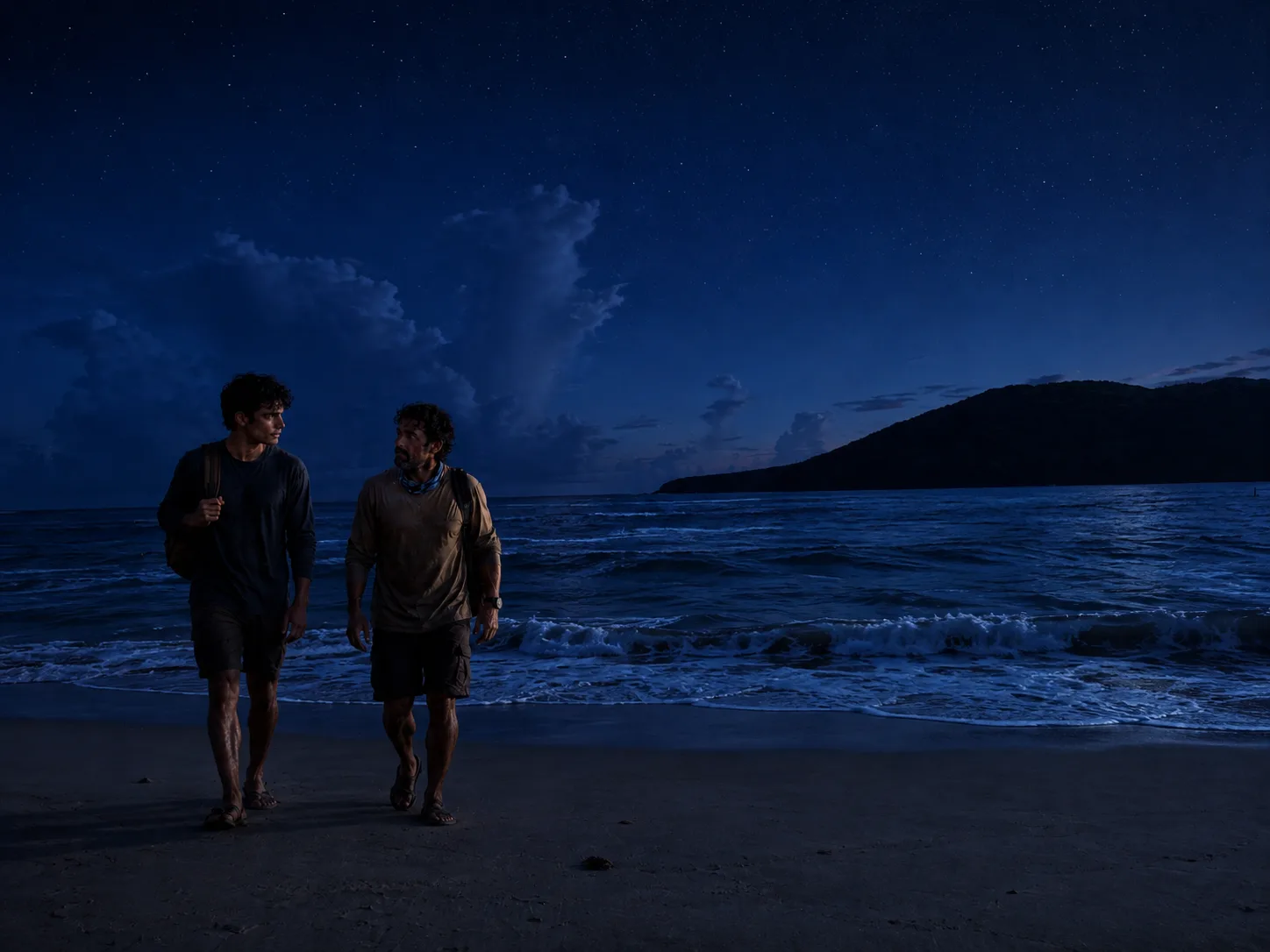
On those nights of perfect darkness, Flamenco Beach stops being the paradise of turquoise water that the tourist brochures portray by day. It becomes a temple of mystery. The silhouettes of the old war tanks left behind by the United States Navy in the nineteen-seventies rise out of the sand like sleeping prehistoric monsters, rusted by the salt air and slowly devoured by the constant surf. It is in this setting that the collective memory of the people of Culebra comes alive, and it is here that Aníbal preferred to spend the last hours of his day, fishing quietly in a mystical connection with the sea.
Aníbal is sixty-nine years old, with a body carved by hard work. His hands are like the mangrove roots of Ensenada Bay — thick, knotted, the skin hardened by long hours under the sun. His eyes, clouded by the beginning of cataracts he refused to have operated on, kept a feline sharpness when it came to reading the ocean. He could look at the water at the Dewey dock and know whether, three nautical miles out, the sea was choppy or the current was running hard from the south.
Beside him, his grandson Tomás represented change, the future and, above all, what the island was beginning to lose. At eighteen, Tomás was a young man who embraced everything modern that the year 1991 brought him. He wore headphones around his neck, listened to rock music, spent his free hours on his skateboard, and did not see fishing as an art or a connection with the universe, but as physical, monotonous, tiring work that his grandfather insisted on imposing on him before he left, in a few weeks, to study at the university in Humacao.
That night, a north wind was blowing with unusual force for the month of July. The two of them were at the eastern end of Flamenco Beach. Aníbal understood that a storm was forming north of the island. The strong winds and torrential rain would not hit them directly, but the sea would turn dangerous along these shores.
“Grandpa, it's getting late. Grandma must have dinner ready,” said Tomás, shaking a nylon net to free the last trapped strands of seaweed. “Besides, you can't see a thing out here. One bad step in the sand and I twist an ankle.”
Aníbal did not answer right away. He stood motionless, his back bent and his face tilted toward the sea, as if he were listening to a secret conversation among the waves.
“Haste is the fisherman's enemy, Tomás,” the old man finally said, without looking at him. “The sea has no clock. If you don't learn to wait in the dark, you'll never know what to look for when the sun comes up.”
“The sea has no clock.”
Tomás sighed in annoyance and put away the last box of hooks. Just as he was about to turn on the flashlight to light the way back, something out on the water froze him mid-motion.
About five hundred yards from shore, just behind the reef barrier where the big waves break before entering the calm horseshoe of Flamenco, a glow appeared. It was not the white, intermittent flash of a navigation buoy, nor the yellow, artificial light of a pleasure boat. It was a perfect sphere of pale bluish light, floating suspended a few inches above the surface of the sea.
“What is that?” Tomás murmured, taking a step forward. The skepticism of his youth collided head-on with the strangeness of what his eyes were seeing. “Grandpa, look. It must be some fisherman outside the reef, but what a strange light he's carrying. Could they be diving?”
Aníbal let out a long breath, a sound that seemed to blend with the wind.
“There are no divers on the outer reef, boy — a storm is forming. Nobody is fool enough to risk having the current smash him against the coral in complete darkness. What you're seeing is the ocean lantern. That is Julián's light.”
Tomás frowned. He knew dozens of island stories: the tales of the pirate Roberto Cofresí and his chests buried on Cayo Luis Peña, the moaning some claimed to hear in the ruins of the Culebrita Lighthouse, the myths about lights that swallowed men whole. But Aníbal's tone was not that of someone trying to frighten a child before bed. There was a solemn respect in his voice, a reverence Tomás had never heard from him, not even when he spoke of the saints in church.
“Who was Julián, Grandpa?” the young man asked, switching off his Walkman. The blue light on the water was now the only guide in the immensity of the beach.
Aníbal sat down on the edge of a piece of driftwood, crossed his worn hands over his knees and fixed his gaze on that bright point rising and falling with the slow rhythm of the waves.
“Sit down, Tomás,” the old man said. “It's time you learned the true story of this sea, so you understand why we respect this coast so much.”
The story began in the early nineteen-forties, when Culebra was a very different place from what it is today. In those days life was hard, rustic and solitary. Residents shared the island with the gunnery exercises of the United States Navy, whose ships bombarded the hills and the northern beaches several times a week. This beach was their favorite for target practice, so access to it was forbidden — though the fishermen slipped in from time to time to fish here. The people of Culebra had to learn to live between the thunder of the cannons, the military restrictions and the silence of isolation.
Julián grew up in that world. Julián was not a tall man, but his shoulders were broad as the trunk of a guayacán and his eyes had the color of deep water, a blue-green that shifted with the light of day. While most of the island's young men dreamed of moving to the main island to work in the factories, Julián wanted only one thing: to be on the sea.
“Julián was different from all of us,” Aníbal recalled, with a nostalgic smile that softened the lines of his face. “We went out to fish out of necessity, to put food on the table or sell a few snappers or grunts in town. Julián went out because the sea seemed to be the only place where his mind found peace. He had an eighteen-foot wooden boat he had built himself from scrap planks with the help of the old carpenters in town. He named her La Milagrosa. She had no modern engine; he used an old motor that coughed and spat black smoke, but he cared for it as if it were a son.”
Julián had a skill that bordered on the supernatural. The island's fishermen spent whole days casting nets and longlines without success, returning empty-handed with their faces burned by the sun. Julián, on the other hand, would head out at midday and come back before nightfall with the hold full of snapper, hogfish and lobster.
“They said Julián talked to the fish,” Aníbal went on. “But the truth is that he watched what nobody else looked at. He could read the behavior of the birds, he understood the meaning of a sudden shift in the clouds coming from Saint Thomas, he knew how the currents changed when the tide rose through the Virgin Passage. But above all, Julián was a man of honor. He had a rule he repeated in the town café every time the rum warmed the conversation: “No one from Culebra should ever be left alone at sea.””
“No one from Culebra should ever be left alone at sea.”
In those days there were no satellite radios and no GPS; not a single fisherman on the island owned a shortwave radio. If a boat ran out of fuel or suffered engine failure outside the bay, it was left at the mercy of the currents. Many times those currents dragged fishermen out into the open ocean, north, where the Atlantic becomes a desert of endless water. Julián was always the first to start his engine when a family in town reported that a husband, a father or a son had not come back at the agreed hour.
“I owe him my own life,” Aníbal confessed, looking Tomás in the eye. “It was in thirty-eight; I was barely sixteen. I had gone out toward Cayo Norte to check some lobster traps. My boat's motor failed and the current was carrying me out to sea. Night fell and I was terrified, crying in the bottom of the boat, waiting for the worst.”
“Suddenly, through the mist and the darkness, I heard the rhythmic coughing of La Milagrosa's engine.”
“It was Julián. He found me in the middle of nowhere, threw me a rope and towed me back to port. When I tried to pay him with the little money I had, he got angry with me. He told me: “Today for you, Aníbal, tomorrow for me. On this sea, we're all the same crew.””
But the sea has no favorites. The sea does not respect the goodness of men, nor their courage, nor their promises. The sea follows only its own physical, destructive laws.
It was October of 1941. Summer had stretched on with a suffocating heat that left the island's few water cisterns completely dry. The old people said that such heat was the omen of something bad.
Julián had set out before dawn toward the fishing banks north of Culebrita, an area rich in fish but dangerous for the coral reefs that break the surface. That day the forecast promised no storms. The sky dawned clean, a pale blue that promised a calm day. But the Caribbean is a stage of treacherous changes. By mid-afternoon the sky began to transform, unleashing a fierce squall.
“The wind swung around in less than ten minutes,” Aníbal recounted, his voice taking on a tremor, as if he were reliving the chill of that afternoon. “Those of us closer to shore gathered everything and ran to secure the boats in the mangroves of Bahía Honda. We knew what was coming was no ordinary downpour. It was a turbonada, a storm of wind and rain so intense that it blinds men and confuses the cardinal points.”
From the shore, the fishermen watched the horizon in horror. The waves began to grow, turning into mountains of gray water that burst with destructive fury against the coral barrier. The noise was deafening; it sounded like the roar of a hundred airplane engines started at once.
Soon the whole town realized that someone was missing. La Milagrosa was not at the dock. Julián was still out there.
“Julián's wife, Asunción, came running to the beach with their little boy in her arms,” Aníbal said, swallowing hard. “She was crying, shouting her husband's name toward the sea, but the wind swallowed her words. The most experienced fishermen looked at one another. No one dared go out. The sea was white with the foam the wind tore off the waves. Trying to cross the coral bar in those conditions was certain death. The mayor at the time tried to reach the Navy to ask for help — a helicopter, a rescue boat — but communications were down because of the storm. Julián was completely alone.”
Over the years, the fishermen have reconstructed what Julián's final hours must have been, based on their knowledge of the sea and the wreckage found afterward.
Julián must have tried to take shelter behind Culebrita, but the wind blew so hard that it pushed his boat toward the treacherous reefs of Flamenco. With an engine that barely had any power and in zero visibility, Julián had to fight wave by wave, keeping the bow of his boat pointed into the danger to keep the water from rolling her over on her side.
“Picture the scene, Tomás,” Aníbal said, pointing at the dark immensity in front of them. “An eighteen-foot wooden boat in the middle of twenty-foot waves. The rain striking your face like stones, the engine failing from the salt water coming in everywhere, and total darkness wrapping around you. Julián had no marine compass that could serve him in the middle of that violent motion. His only hope was to see some light on the shore of Flamenco, some sign that land was near. But there were no lights on the beach. The storm had caused a blackout across the whole island. Culebra was a black shadow in the middle of a furious ocean.”
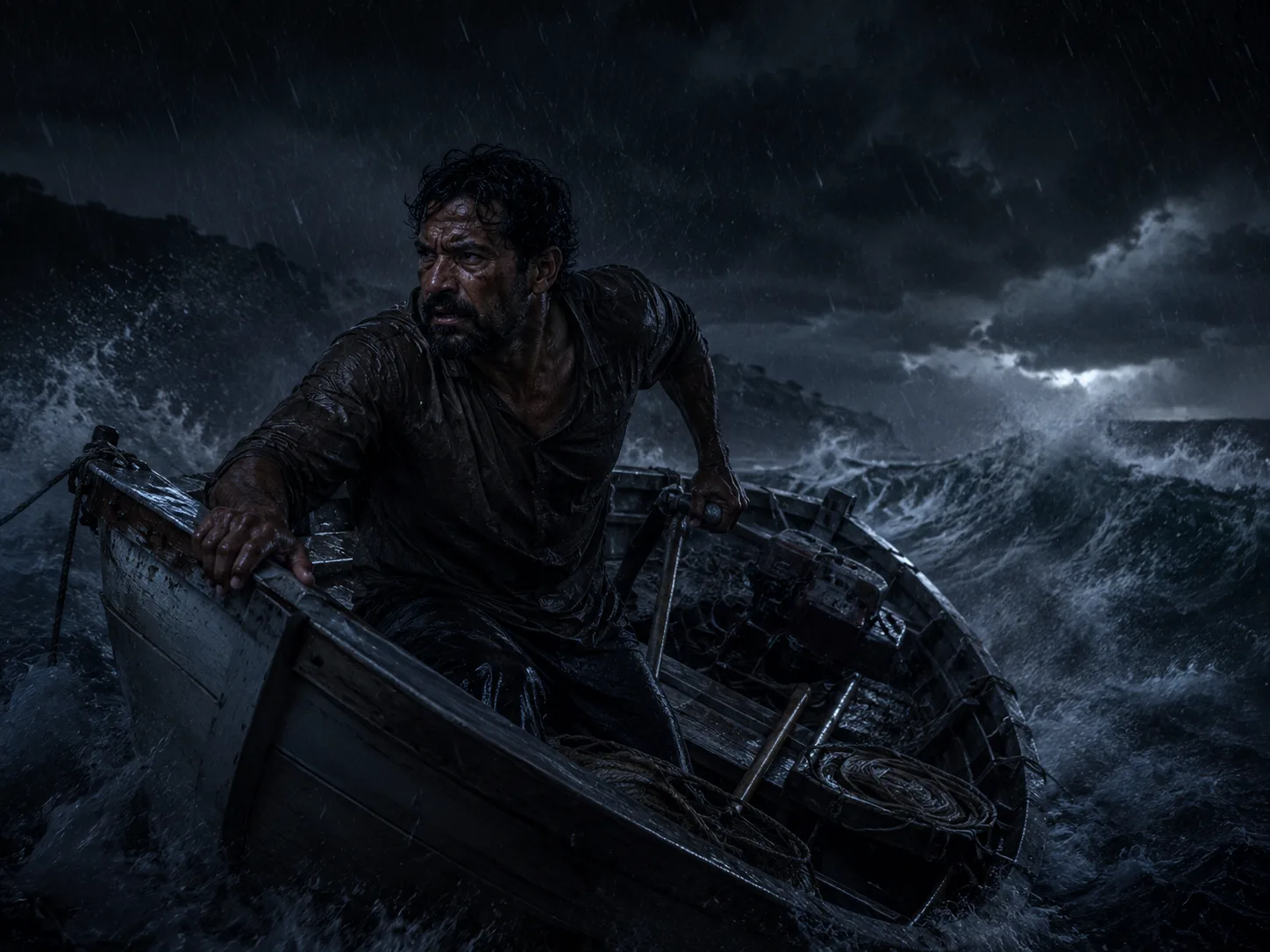
The storm roared all night long. No one on the island slept. Residents spent the hours praying in their wooden houses, listening to the creak of zinc roofs and the constant impact of debris hurled by the wind. When the first rays of sun broke through the mist the next morning, the scene was devastating. The sea, with that hypocrisy only the ocean possesses, awoke in a suspicious calm, its water tame, crystalline and blue, as if apologizing for the violence of the hours before. The fishermen formed search parties at once. They combed every meter of coast that was not restricted area — though they managed to slip into Flamenco. They searched from Punta Flamenco to El Resuello. It did not take long to find the answers. Enormous pieces of wood painted white and blue, the distinctive colors of La Milagrosa, appeared scattered along the shoreline, and the engine was found among the sharp rocks of the reef at the eastern end of the beach.
“We found his fishing cap, his torn nets and the remains of his toolbox,” Aníbal said, his voice going flat. “But Julián… Julián we never found. The Atlantic is deep and its currents can drag a body many miles in a matter of hours. We searched for weeks. Divers looked in the depths, but there was no trace of him. The ocean kept him forever.”
The loss of Julián left an immense emptiness in the small community of Culebra. For months an air of mourning and silence hung over the docks of Dewey. Asunción, his widow, ended up moving to the main island with her son, unable to bear the pain of looking every day at the same sea that had taken her husband.
Julián was gone, but his phrase — “No one from Culebra should ever be left alone at sea” — stayed engraved in the minds of everyone who lived from fishing. It was exactly one year after the tragedy, on the first new-moon night of October, that the mystery began.
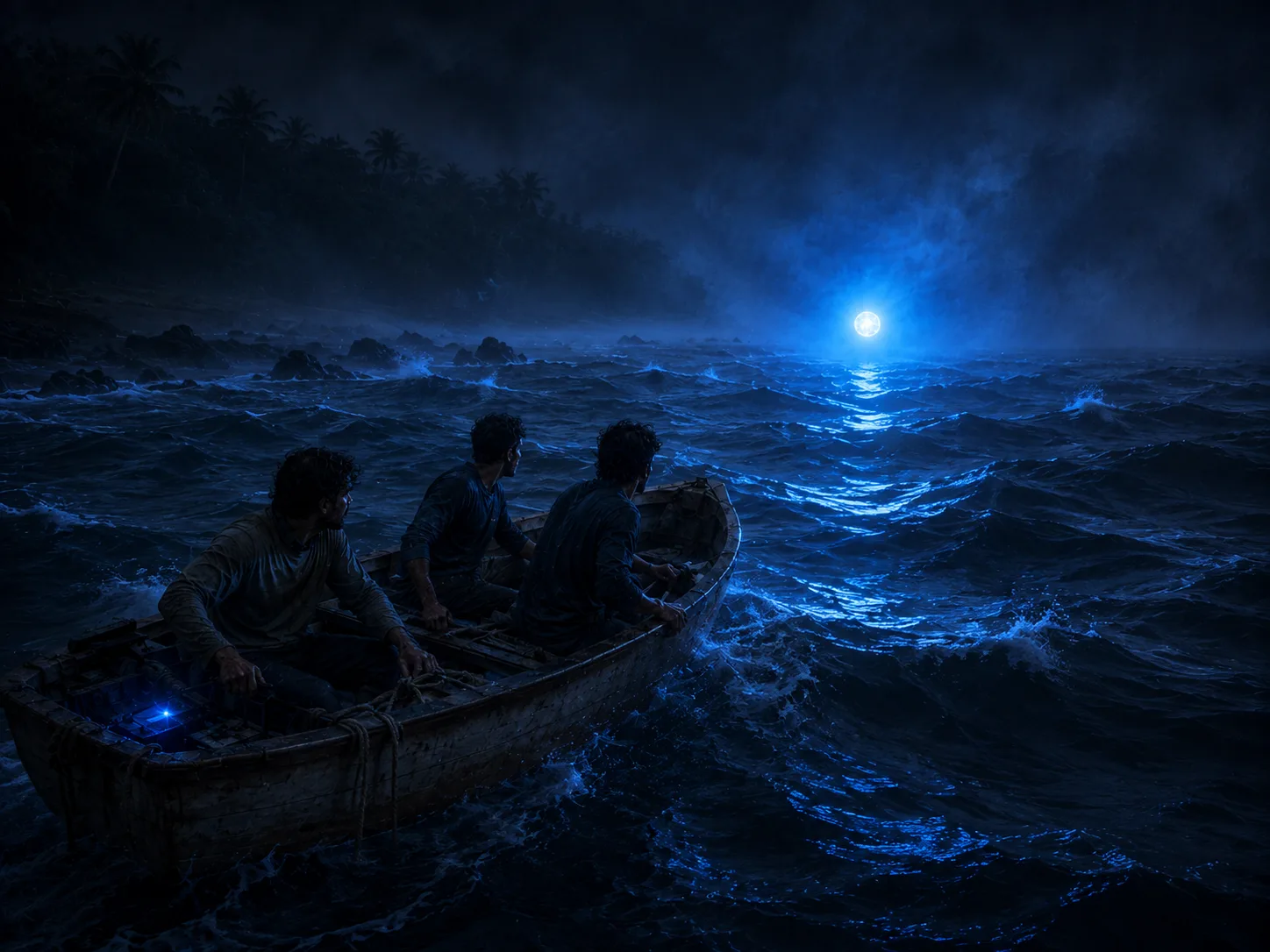
“That night, three veteran fishermen, my older brother among them, were coming back late from Cayo Luis Peña and heading for Carlos Rosario Beach to finish their trip,” Aníbal explained. “They were in a small boat and misjudged the time. Darkness caught them before they entered the channel. To make matters worse, a dense sea fog — one of those that come down off the island's hills and spread over the water — covered the whole area. They were disoriented, drifting, knowing they were near the coast but afraid to move forward for fear of striking the shallow reefs of Flamenco. Suddenly, as the three men each told it separately the next day, the fog opened. Right in the middle of the safe channel, in the only deep passage where the coral does not cut the wood of a boat, a bluish light appeared.”
“At first they thought it was a coastal police patrol or the Navy,” Aníbal said. “My brother shouted for help, but no one answered. The light gave off no engine sound. It simply floated, always staying about fifty yards ahead of their boat. My brother, who had a special instinct, told the man at the helm to follow that light; he didn't know what it was, but it gave him confidence.”
The boat moved slowly forward, following the trail of the luminous orb. The light moved with astonishing precision, avoiding every coral head, every sandbar and every hazard along the coast. It guided them gently through the dark labyrinth of the reef until the boat's keel brushed the soft sand of Flamenco Beach. At the exact instant the men climbed out and their feet touched the firm sand of the shore, the light stopped. It gave a bright flash, a quick pulse that lit up the astonished faces of the fishermen for a second, and then slipped beneath the water smoothly, vanishing completely without leaving a single bubble.
“When they got to town and told the story, the younger men laughed at them,” Aníbal remarked, looking at Tomás. “They said it was the rum they had in the boat, or minds worn out by fear of the dark. But a few weeks later it happened to another fisherman. And then to a group of merchant sailors bringing provisions from Fajardo.”
They all described the same thing: a blue light that appeared only on new-moon nights, only when someone was lost or in danger near Flamenco Beach, and that always guided them along the safe route toward Punta Tamarindo, Carlos Rosario Beach or, if necessary, to this very shore here at Flamenco, before disappearing into the water.
The old people of the island needed no further proof. They knew perfectly well who it was. Julián had come back. Not as a wandering ghost seeking revenge or frightening the living with its moaning, but as the eternal lighthouse the island needed. His soul had fused with the ocean, becoming the definitive guardian of the waters of Culebra.
Tomás listened to his grandfather's account without taking his eyes off the blue light on the horizon. The luminous sphere was still there, floating with a startling calm, indifferent to the scientific explanations the young man was desperately trying to formulate in his mind.
“Grandpa,” Tomás said, in a voice that no longer carried the arrogance of the beginning, “there has to be a logical explanation for that. I've read about bioluminescence in school. On Vieques, in Mosquito Bay, and right here in some parts of Culebra, there are microorganisms in the water — dinoflagellates — that glow when the water is stirred. Maybe the waves hitting the reef are activating those organisms, and that's why we see the glow.”
Aníbal smiled gently, a smile loaded with the patience of someone who has heard the same doubts for decades.
“I know what bioluminescence is, Tomás,” the old man replied. “I've seen the water light up when I dip the oars in the mangroves on nights like this. That glow is beautiful, but it's a wake that fades in seconds; it needs the movement of the water to exist. What's out there is not a wake of thousands of microbes. It's a single point of concentrated light. It doesn't move with the current of the water — it moves against it, if it has to. Look carefully.”
Tomás sharpened his gaze. His grandfather was right. The swell was pushing hard toward the west end of the beach, but the blue light was drifting slowly east, keeping a constant height above the water, unmoved by the rise and fall of the waves breaking beneath it.
“Besides,” Aníbal added, “bioluminescence doesn't choose who to save. It doesn't appear out of nowhere when a sailor is praying for his life in the middle of the fog, and it doesn't go out at the exact moment you touch solid ground. Science explains the body of the sea, Tomás, but it doesn't explain its spirit. Men from the city believe everything can be measured with numbers and explained in books, but when you're alone in the immensity of the ocean at midnight, you realize there are forces beyond our understanding.”
“Science explains the body of the sea, but not its spirit.”
The young man fell silent. He felt a shiver that had nothing to do with the cold north wind. He looked around him: the black immensity of the beach, the dark silhouettes of the trees, the rusted war tanks that seemed like mute witnesses to the island's history. For the first time in his life, Tomás felt small. He understood that the island where he was born was not just a piece of land with pretty beaches for tourists, but a sacred place, charged with a living history passed on through the voices of elders like his grandfather.
“Have you seen it up close, Grandpa?” Tomás asked in a whisper, afraid the wind would break the spell of the moment.
“Only once,” Aníbal confessed, his gaze seeming to lose itself in the memory. “It was many years ago. You were still a small boy. It was in 1975, the same year the United States Navy withdrew from Culebra. Flamenco was still restricted because of the danger of live ordnance in the water or on the shore, but we always found a way. We had gone out to fish beyond the coral barrier and the engine broke down. I tried to start it dozens of times until my hands bled. Darkness fell on us and the current was pushing us dangerously toward the rocks of Punta Flamenco. We were about to run aground; we could hear the dull blow of the water against the living stone. In that moment of desperation, I remembered Julián. I knelt in the bow, put my hand on the salt water and said to him: “Julián, brother, my son is with me in the boat. Don't leave us alone.””
Aníbal paused, and a single tear rolled down his sun-worn cheek, shining for an instant before it was lost in the sand.
“Not two minutes had passed when the blue light appeared right in front of our bow,” he went on. “It wasn't a blinding light; it was a soft, peaceful glow that carried an absolute calm. The moment it appeared, fear left the boat. I followed the light with the oars, using it as a guide to keep the boat centered in the channel. It brought us exactly to this very spot where we're standing today. When the keel touched the sand, I looked ahead and saw the light rise a few inches above the water, give a flash identical to the smile Julián used to give when he came back with a good catch, and sink into the sea. The most skeptical said the light was some kind of military equipment, above all because the greatest number of sightings happened in the fifties and sixties. When I saw Julián, the Navy had already withdrawn. From that day on, I have never doubted again. I'm one of the last who can say he saw the light. After the Navy left, the sightings practically disappeared; that's why many believe the light was part of some military exercise. But, as you can see, it's still there. What happens is that nobody looks at the sea carefully anymore; everyone is focused on modern things,” Aníbal said, glancing at his grandson's Walkman. “Young people have lost their respect for the sea and, with all the modern equipment many fishermen have today, they forget the basics. Someday this beach will be more popular, more touristic, with more lights among the palm trees, and people won't look at the sea searching for any mystical light. But it doesn't matter; it doesn't matter that no one pays attention to the sea. Even if no one sees Julián's light, he will always be in these waters, protecting anyone who gets lost in bad weather.”
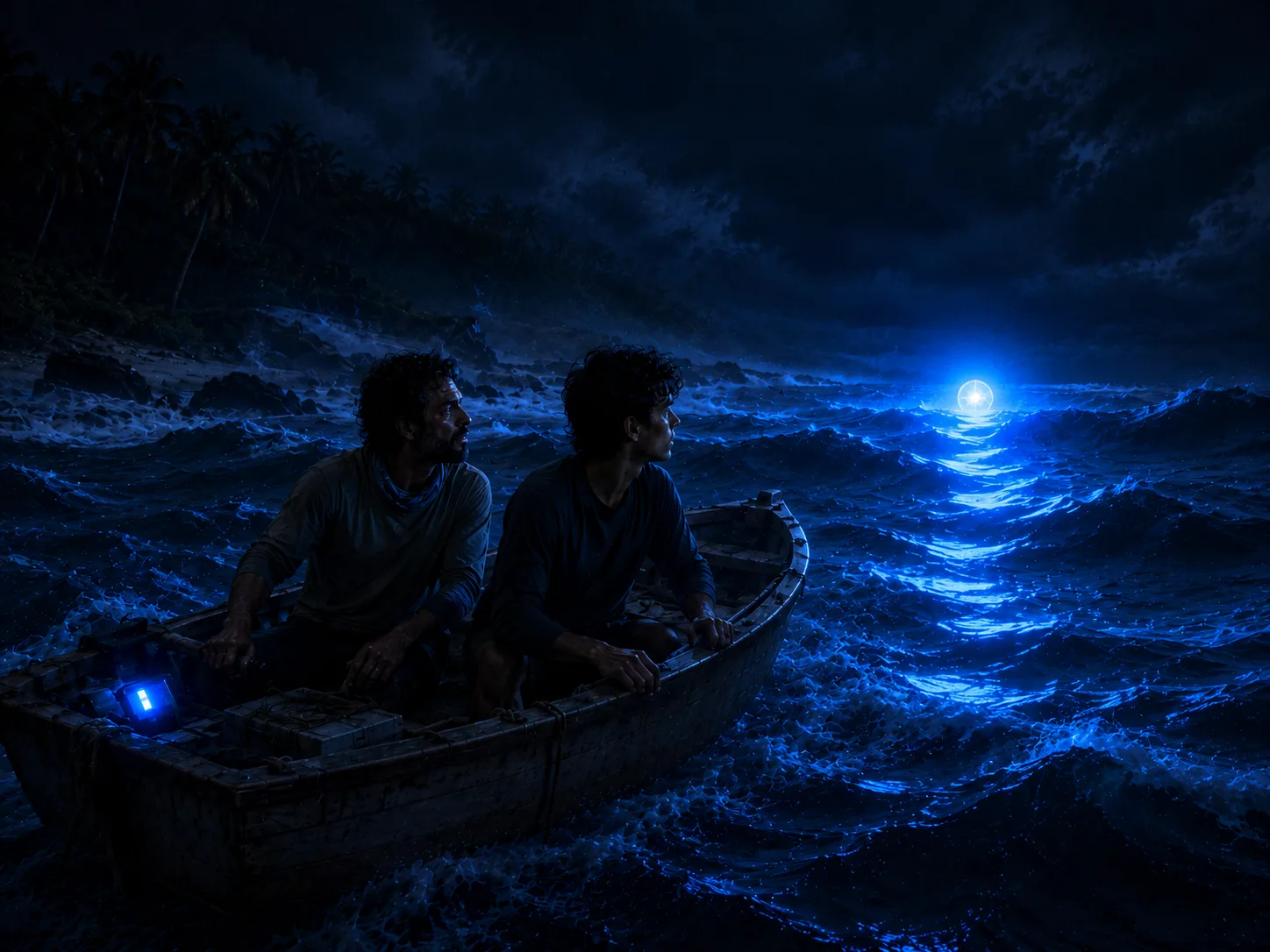
Time seemed to stop at Flamenco Beach. Grandfather and grandson stayed sitting on the edge of the boat for what felt like hours, watching the silent dance of the ocean lantern. The blue light continued its patrol along the reef barrier, moving from one end of the bay to the other like a faithful sentinel guarding the gates of a castle.
A little before eight o'clock, the clouds to the north began to break apart, revealing a star-filled sky of astonishing clarity. Thousands of bright points decorated the vault of the heavens, reflected on the calm surface of the Flamenco horseshoe. With the arrival of the stars, the blue light began to lose intensity, dimming gradually, as if it knew the world was no longer in total darkness.
Aníbal got to his feet with difficulty, stretching his legs and shaking the sand from his trousers.
“It's time to go, Tomás,” he said in a tired but peaceful voice. “The light is resting now. The night is clear and sailors can see the stars to guide themselves.”
Tomás did not answer right away. He stood up and stared at the point where the blue sphere had faded. The sea was completely calm now, a black mirror reflecting the Milky Way.
The young man felt that something inside him had changed. The disdain he felt for his grandfather's trade, the impatience to leave the island and the disconnection from his roots had dissolved in the darkness of the beach. He understood that fishing was not simply pulling fish out of the water; it was being part of an unbroken chain of men who looked after one another, a link in a tradition of mutual respect between humanity and the ocean.
“Grandpa,” Tomás said as they walked along the dark path leading home a few miles away, “I want to go out fishing in the boat with you. I don't care if the sea is rough. I want you to teach me to read the currents of the Culebrita channel.”
Aníbal stopped for a second. He looked at his grandson through the gloom and a smile of infinite pride spread across his tired face. He laid one of his heavy hands on the boy's shoulder.
“Now you're talking, boy,” said the old fisherman. “Julián would be proud to hear that. As long as there is someone on this island who remembers his name and respects the sea, his light will never stop shining.”
The two continued on their way beneath Culebra's blanket of stars. Behind them, in the mystical waters of Flamenco Beach, the Atlantic Ocean went on beating in silence, keeping in its depths the soul of the fisherman who promised never to leave his brothers alone in the darkness.
The End
About the author
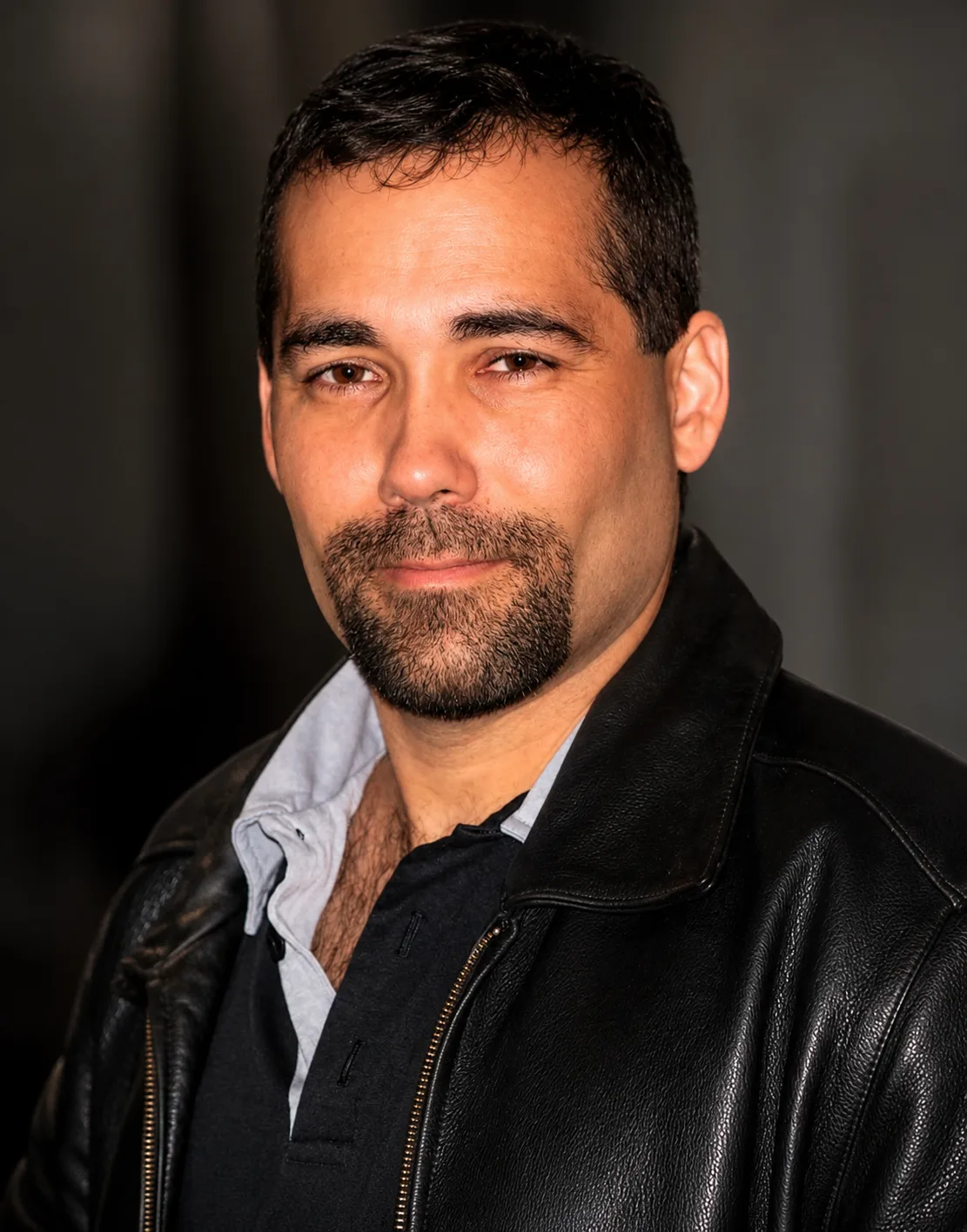
Efraín Nadal de Choudens
Efraín Nadal de Choudens is a Puerto Rican writer and the author of The Ocean Lantern. His work draws on the oral tradition of the Caribbean: the stories told on the docks, in the corner cafés and in family kitchens, where the memory of a community is kept without any need for archives.
In this story he takes one of the most beloved beliefs of the Culebra coast — the light that appears on dark nights to guide the lost — and turns it into a tribute to the fishermen who made the sea into a community.
Editorial note
The Ocean Lantern is published in The Culebra Insider Guide with the author's permission and presented as it was written. The English version is a literary translation of the Spanish original.
The characters and plot are works of fiction, but the world they portray is real: the Navy years at Flamenco, the moonless nights, the sudden storms, and the unwritten rule that no one is left alone at sea. Stories like this one are part of Culebra's living heritage, and publishing them is one way of caring for them.